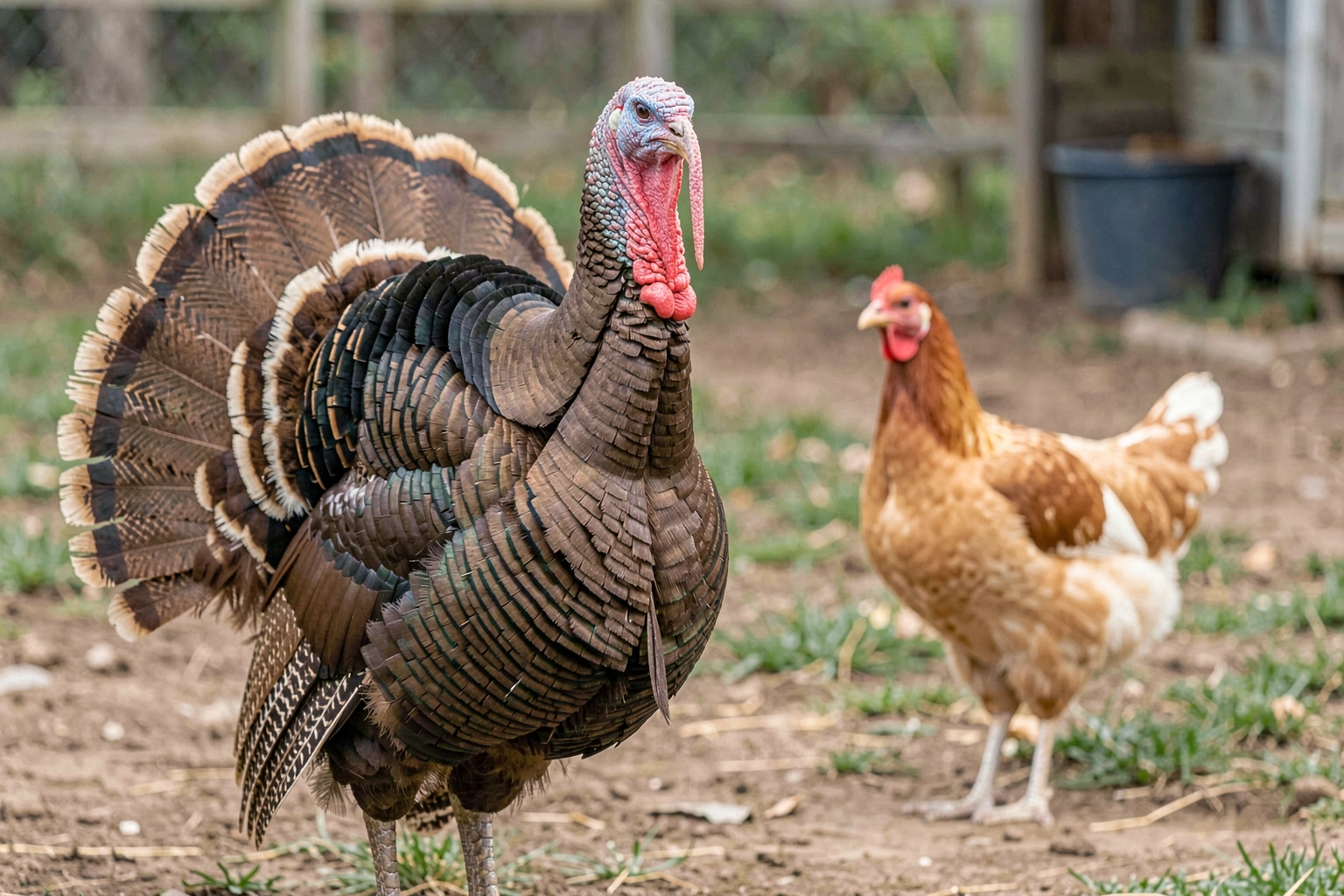
No, a turkey is not a bird of prey. Turkeys are large, ground-foraging omnivores that belong to the same family as pheasants and peacocks. They scratch through leaf litter looking for acorns and berries, not scan from high perches looking for animals to kill. If you spotted something big and aggressive in a field or your backyard and wondered whether it was a raptor of some kind, the short answer is: turkeys and birds of prey are completely different categories of bird, with different anatomy, different diets, and different hunting behaviors.
Is a Turkey a Bird of Prey? Clear Checklist and Facts

Marcus Hendricks
22 Mar 2026
What "bird of prey" actually means
The term "bird of prey" and the word "raptor" are used interchangeably in wildlife biology. The California Department of Fish and Wildlife defines raptors as hawks, falcons, kites, eagles, vultures, and owls. The U.S. Fish and Wildlife Service adds condors to that list. These are birds built specifically to find, catch, and kill other animals, and their anatomy reflects that job description in very specific, visible ways.
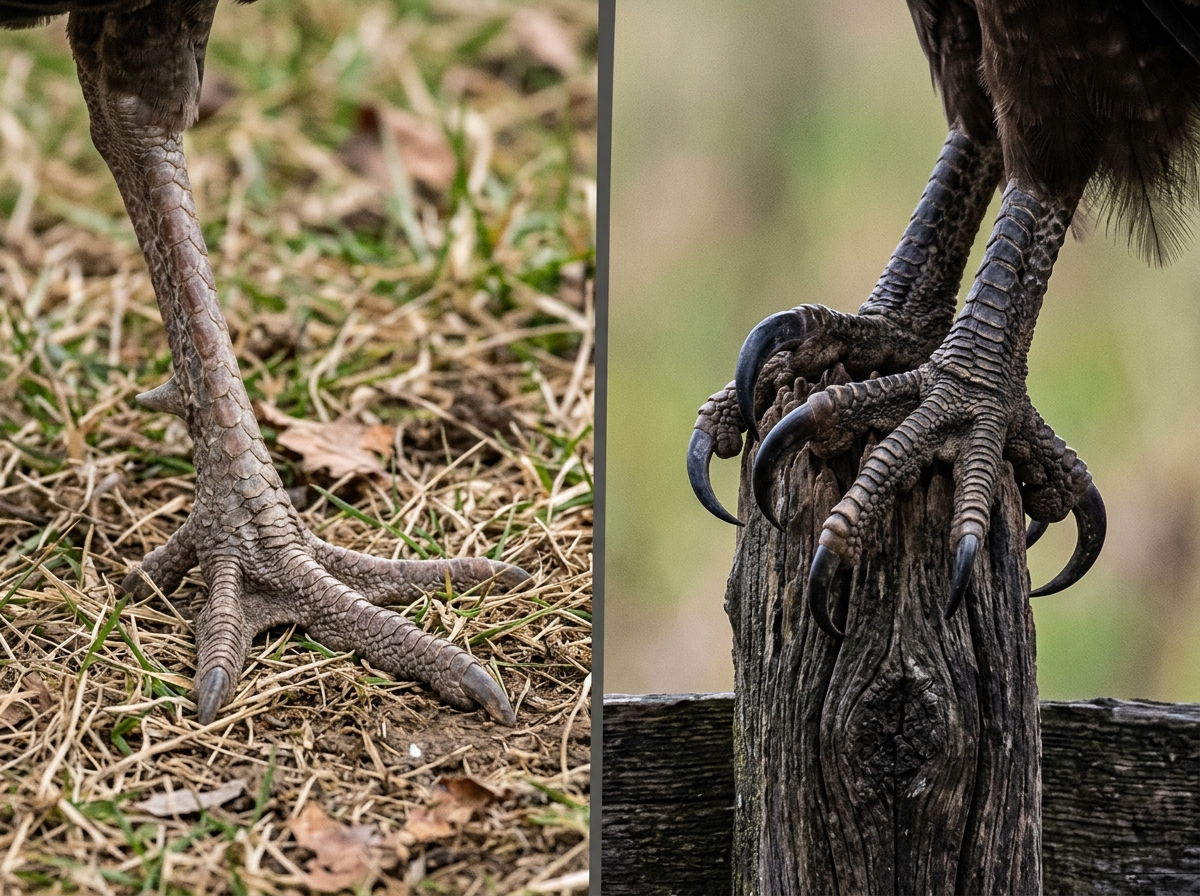
At the feet, the difference is just as stark. Raptors have talons, which are long, curved, sharp claws specifically adapted to pierce, grip, and kill prey. Turkey feet have shorter, blunter claws suited for scratching ground. Male turkeys (toms) have a spur on the back of each leg, which they use in fights with other males, but a spur is not a talon and it's not used for hunting. A turkey's beak is also not hooked in the sharp, downward curve you see on a hawk or owl. It's a relatively straight, sturdy beak suited for picking up seeds and scratching through debris, not tearing into prey.
So when you're trying to answer the bird-of-prey question for any species (and if you're curious how this plays out for other birds, the question of what makes a bird a bird of prey is worth its own read), the checklist comes down to anatomy and behavior: hooked beak, killing talons, forward eyes, and active predation of vertebrate prey. Turkeys don't check any of those boxes in the way raptors do.
So is a turkey a bird of prey? Here's your direct answer
Turkeys are not birds of prey. They are classified as upland game birds in the order Galliformes, alongside chickens, quail, and pheasants. Raptors sit in entirely different taxonomic orders (Accipitriformes for hawks and eagles, Strigiformes for owls, Falconiformes for falcons). The biological separation isn't subtle or a matter of debate. Turkeys are built to survive and forage, not to hunt and kill. Their anatomy, diet, and daily behavior all point in the same direction.
What turkeys actually eat
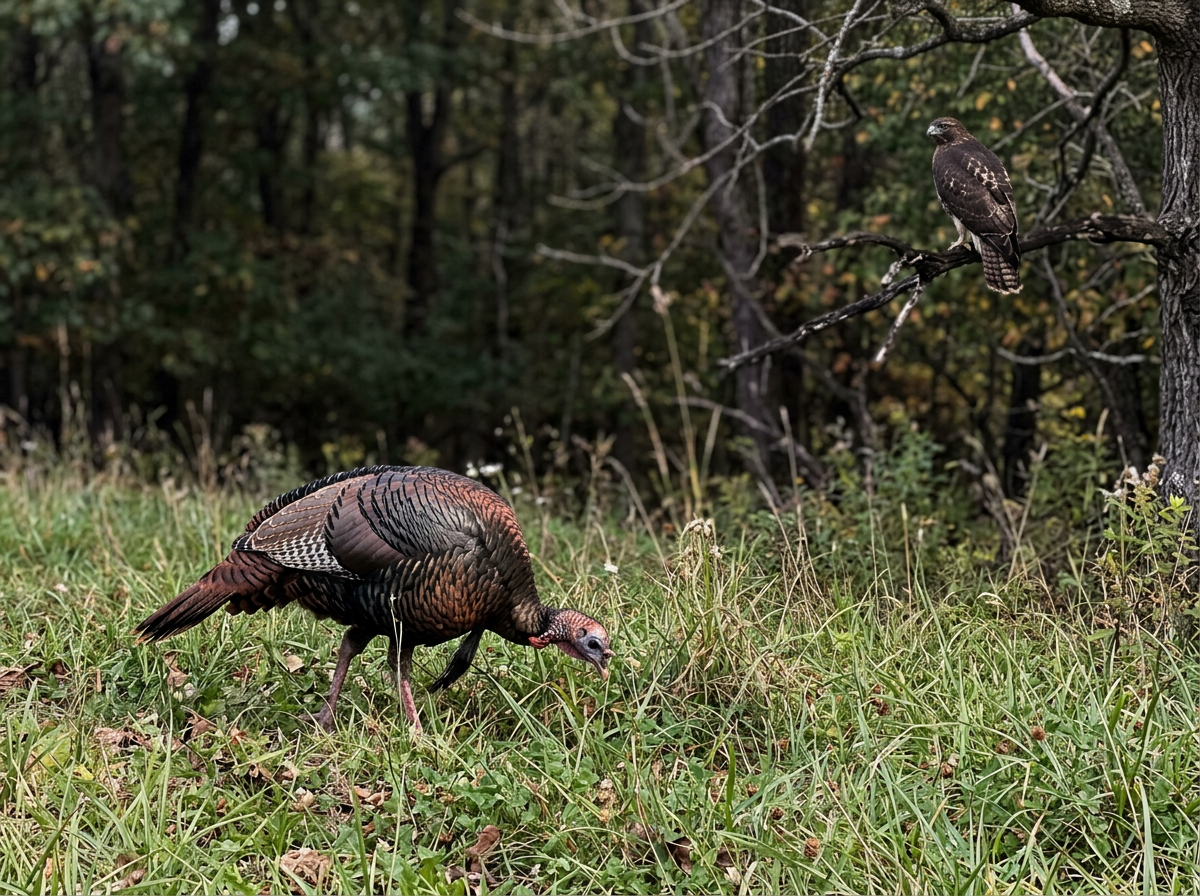
Wild turkeys are omnivores, but heavily weighted toward plant material. Oklahoma State University Extension reports that roughly 90 percent of an adult turkey's diet is plant-based: acorns, seeds, leaves, berries, roots, grass blades, and grain. The Audubon Society's field guide describes turkeys feeding by scratching through leaf litter to uncover food, with the most active foraging happening in early morning and evening.
The remaining portion of the diet includes insects, snails, worms, and occasionally small frogs, salamanders, or other tiny vertebrates. Florida Fish and Wildlife and Maine's wildlife agency both document this. Young turkeys (called poults) rely heavily on insects for protein in their first weeks of life, according to U.S. Forest Service species data. So yes, turkeys do eat small animals, but eating a bug or opportunistically snapping up a small frog is a long way from the active, pursuit-based predation that defines raptors.
The National Wild Turkey Federation frames it well: turkeys are, in a sense, predators of insects and the occasional small animal, but they are also prey for many larger predators. That dual role is very different from the position a hawk or eagle occupies in the food chain.
Turkey anatomy doesn't match the raptor blueprint
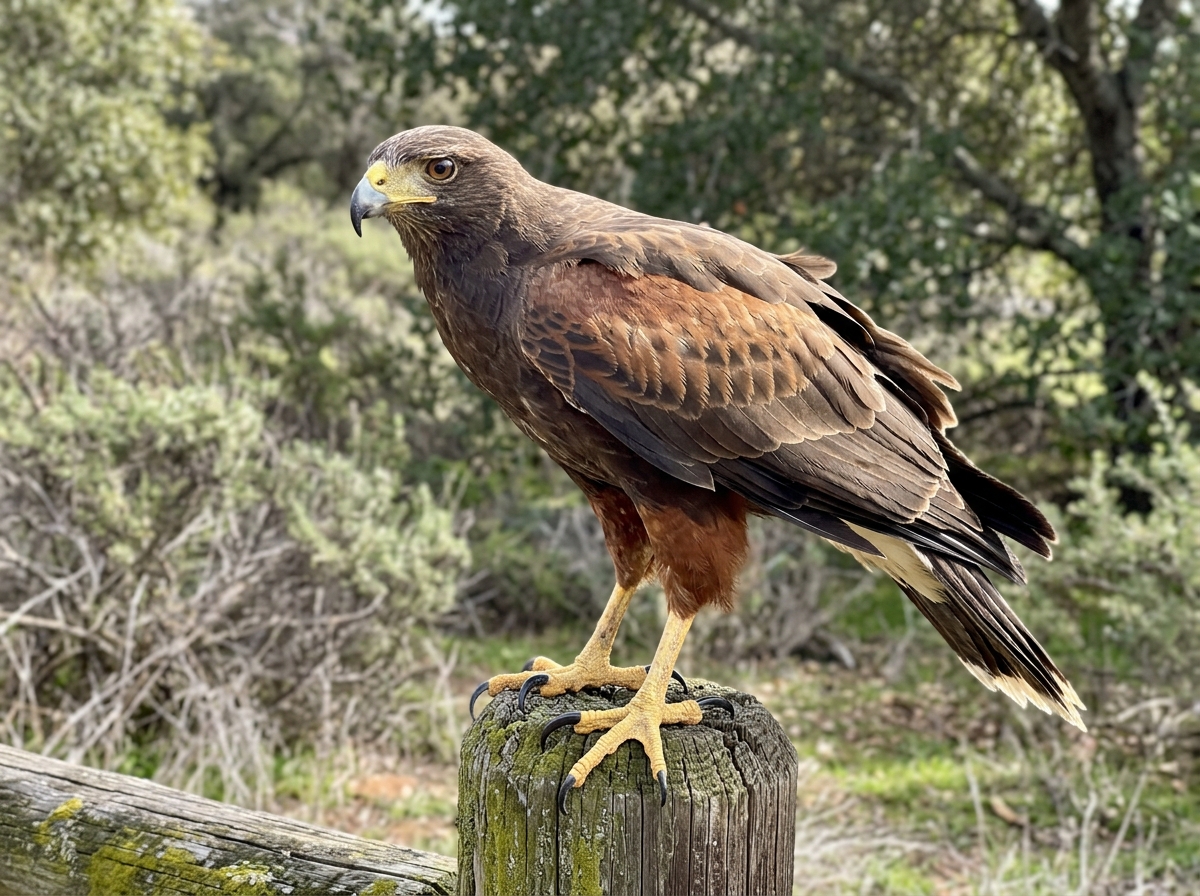
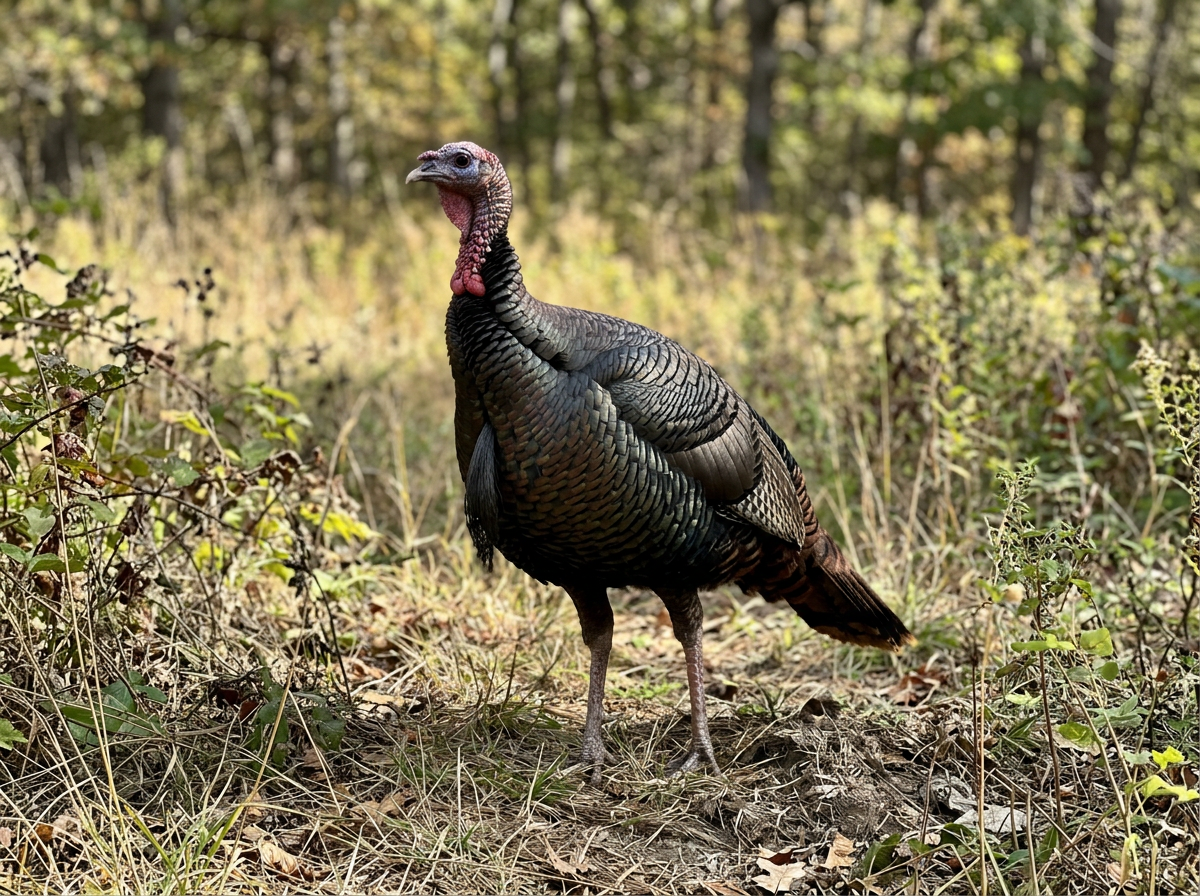
This is where the comparison gets really concrete. Put a turkey and a red-tailed hawk side by side (in a photo, obviously) and the differences jump out fast. Cornell Lab's All About Birds describes the wild turkey's silhouette as a very large, plump body with a long neck and legs and a wide, rounded tail. Audubon adds a naked head and a broad, fanned tail as the key visual cues. That profile is nothing like a raptor's compact, streamlined body with a hooked head and tucked wings.
At the feet, the difference is just as stark. Raptors have talons, which are long, curved, sharp claws specifically adapted to pierce, grip, and kill prey. Turkey feet have shorter, blunter claws suited for scratching ground. Male turkeys (toms) have a spur on the back of each leg, which they use in fights with other males, but a spur is not a talon and it's not used for hunting. A turkey's beak is also not hooked in the sharp, downward curve you see on a hawk or owl. It's a relatively straight, sturdy beak suited for picking up seeds and scratching through debris, not tearing into prey.
Why turkeys sometimes look "predatory" (and why they're not)
This is where most of the confusion comes from. Turkeys can look genuinely intimidating, and in some situations they act aggressively. A tom turkey in breeding season puffs out his feathers, fans his tail, gobbles loudly, and struts around with obvious confidence. Massachusetts wildlife officials specifically call out this spring behavior as a dominance display, not a predatory one. The U.S. Fish and Wildlife Service notes that toms fan their tails and swagger to attract mates and push away rival males.
The National Wild Turkey Federation has even documented turkeys using a full tail-fan as a threat display when they sense danger overhead, including one case recorded near a bald eagle. So the body language that looks aggressive or "predatory" to a casual observer is actually a social and defensive communication system, not a sign that a turkey is gearing up to hunt.
Turkeys that have lost their natural wariness of people (usually because someone has been feeding them) can become pushy or even charge at people. That's a dominance behavior, the same logic that drives two toms to fight over a hen. It has nothing to do with predatory drive. A raptor hunting is a fundamentally different thing: it involves scanning from elevation, identifying prey from a distance, and executing a stoop or strike. Turkeys don't do any of that.
Daily turkey behavior, as documented by the NWTF, is dominated by walking, foraging, grooming, dusting, and competing for social rank on the ground. They roost in tall trees overnight and fly down at dawn, but their flying is for safety and roosting, not hunting. Audubon notes turkeys usually get around by walking or running, and can fly strongly when needed.
Turkey vs. raptor: side-by-side comparison
| Trait | Wild Turkey | Raptor (hawk/eagle/owl) |
|---|---|---|
| Classification | Galliformes (upland game bird) | Accipitriformes / Strigiformes / Falconiformes |
| Beak shape | Straight, sturdy, seed/scraping beak | Hooked, sharp, tearing beak |
| Feet/claws | Short, blunt claws; spur on toms | Long, curved, sharp talons for killing |
| Eye placement | Sides of head (wide field of view) | Forward-facing (binocular vision) |
| Primary diet | ~90% plant material; some insects/small animals | Vertebrate prey (rodents, fish, rabbits, etc.) |
| Hunting behavior | Ground foraging, scratching leaf litter | Elevated perching, stooping, active pursuit |
| Body silhouette | Large, plump, long neck/legs, wide rounded tail | Compact, streamlined, hooked head profile |
| Aggression context | Social dominance and mating displays | Predation and territory defense |
If you're trying to decide whether something you saw is a turkey or a bird of prey, the body shape alone usually settles it fast. Turkeys are unmistakably large and ground-oriented, with that wide fanned tail. Raptors in flight show a very different silhouette: compact body, held-back wings during a stoop, and a distinctly hooked beak visible even at distance.
How to tell a turkey from a bird of prey in the field
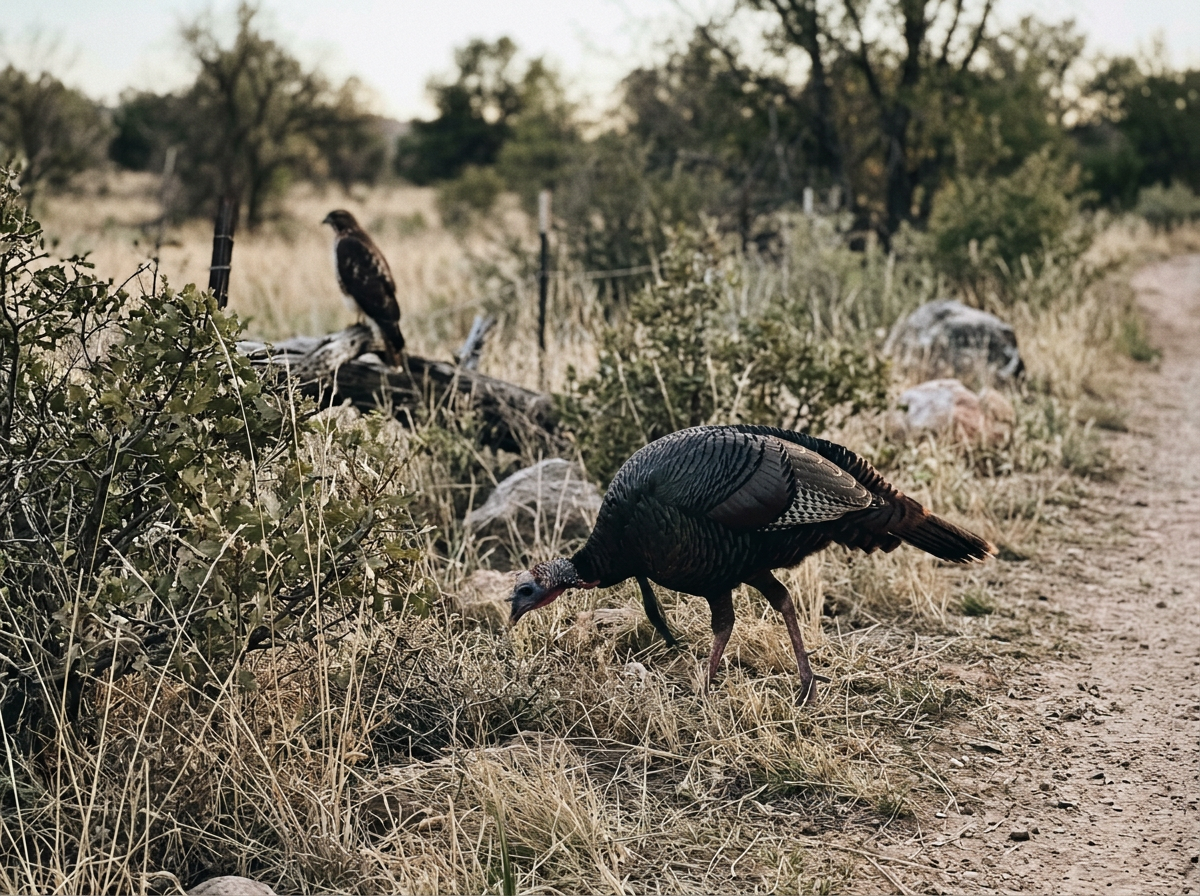
If you're trying to ID what you're looking at right now, run through this checklist. It works whether you're in a backyard, a park, or out on a trail.
- Check the size and body shape: Turkeys are very large and plump with long legs and a small head on a long neck. Raptors are generally more compact and streamlined relative to body length.
- Look at the tail: A turkey's tail is wide and rounded, often fanned out. Hawks have narrower, banded tails; eagles have broad, flat tails; owls have short, rounded tails.
- Watch where it's standing or moving: Turkeys walk and scratch on the ground. Raptors perch at elevation (fence posts, treetops, telephone poles) and scan from there.
- Check the beak if you can: A turkey's beak is relatively straight. A raptor's beak curves sharply downward at the tip, even visible in profile at moderate distances.
- Look at the feet: If you can see the feet, raptor talons are visibly long and curved. Turkey feet look more like large chicken feet.
- Check eye placement: Raptor eyes face forward, giving a flat-faced or owl-like look. Turkey eyes sit on the sides of the head.
- Watch the behavior: Is it scratching through leaves and pecking at the ground? Turkey. Is it perching motionless, scanning, then diving at something? Raptor.
- Listen: Turkeys gobble, cluck, and make a range of social calls. Raptors call with screams, whistles, or hoots depending on species.
One more thing worth noting: if you're curious about a specific bird you've seen and it seems like it might be related to this question (for example, if it looks like a large dark bird circling overhead), it's worth knowing that a bird-of-prey question are completely separate species that does qualify as a bird of prey in many definitions, and they're commonly confused with other large birds. That's a topic covered separately, but the quick distinction is that turkey vultures soar with wings held in a V shape and have a small red head, while actual wild turkeys stay mostly on the ground.
Bottom line: turkeys are fascinating, surprisingly complex birds, but they are not birds of prey. They're omnivorous ground-foraging game birds that look intimidating when a tom is in full display mode, but that's social theater, not predation. If you're watching one strut across your lawn, you're watching a bird that's much more interested in your garden seeds than in hunting anything down.
FAQ
If a turkey eats small animals, does that make it a bird of prey?
In most cases, no. A turkey may peck at small animals opportunistically, but it does not actively hunt vertebrate prey the way raptors do (no stoop or kill sequence). If you see repeated stalking, pursuit, or carrying prey in talons, you are likely looking at a raptor, not a turkey.
Could a turkey be mistaken for a bird of prey when it’s flying or circling overhead?
Probably not. Turkeys are mostly ground walkers and rely on visibility and foot speed, while raptors hunt using vision from above, then execute a direct strike. If the bird is circling high to “look down” and then diving at prey, that’s a raptor behavior pattern.
What’s the fastest way to distinguish turkey feet or beak from raptor features at a glance?
A key tell is where the feet are used and what the beak looks like in motion. Raptors typically use large curved talons for grabbing and holding prey, and their beak is clearly hooked. Turkeys have blunter claws built for scratching, and their beak is straighter, built for picking up seeds and probing debris.
Do turkey spurs mean turkeys are predatory like raptors?
No. Tom turkey spurs are for fighting and dominance among other turkeys, not for killing food. Raptors’ defining “weapon” is the talon shape and grip mechanics, not a leg spur used in male-to-male contests.
Why might a turkey act aggressive or charge me, and does that indicate predation?
It can happen, especially near people who feed them. Handouts can reduce fear and increase aggressive approach behavior, including puffing, chasing, or charging. Even then, it’s social and defensive behavior, not the hunt-and-capture strategy raptors use.
Do turkeys hunt from trees the way owls or hawks do?
Not typically. Turkeys roost in trees or tall shrubs for safety and drop down at dawn, but they generally don’t use flight to chase prey. If the bird consistently flies low to pursue targets or repeatedly grabs and carries prey, that points away from turkeys.
How can I tell whether the bird in my yard is foraging like a turkey or hunting like a raptor?
For backyard situations, check for diet patterns and time of day. Turkeys usually forage on foot (scratching leaf litter) early morning and evening, and they prefer plant foods most of the time. Raptors may be seen more often perching and scanning, then making quick strikes when prey appears.
If I only get a distant silhouette, what visual cues help decide “turkey vs bird of prey”?
Often the body shape is the clue when you cannot see the beak clearly. Turkeys tend to look broad and heavy with a rounded, fanned tail, and the stance stays ground-oriented. Raptors usually look more streamlined, with a different wing posture in flight, especially during dives.
Could a turkey vulture be causing the confusion in the “turkey vs bird of prey” question?
If it’s a turkey vulture, the answer depends on what you mean by “bird of prey.” Turkey vultures are raptors, but they are scavengers rather than active hunters like hawks and falcons. If you see a bird with a V-shaped wing posture and a bare, lighter head, it may be a vulture rather than a turkey.
What should I do if I see wild turkeys repeatedly around my home, especially if they seem too confident?
Yes. When people feed wild turkeys, the birds may stick around longer and become bolder, which can make them seem more dangerous than they are. A safer approach is to stop feeding, keep distance, and secure trash or pet food so the birds have less reason to associate people with food.
Next Article
Is Turkey a Bird or a Chicken? Direct Answer and Differences
Turkey is a bird, not a chicken. Key biological and practical differences like feed, incubation, and flight.